
We Do Books™ Blog

Michael DiSabatino of We Do Books™ shares expert insights to help you unlock your business's full potential by delivering proven strategies for maximizing tax savings, streamlining operations, and driving sustainable growth.

The information provided on this site is for general informational purposes only and should not be construed as professional financial, tax, or legal advice. For advice tailored to your specific situation, we recommend consulting with a qualified professional. We Do Books is here to assist by calling 855-922-WeDo (9336)

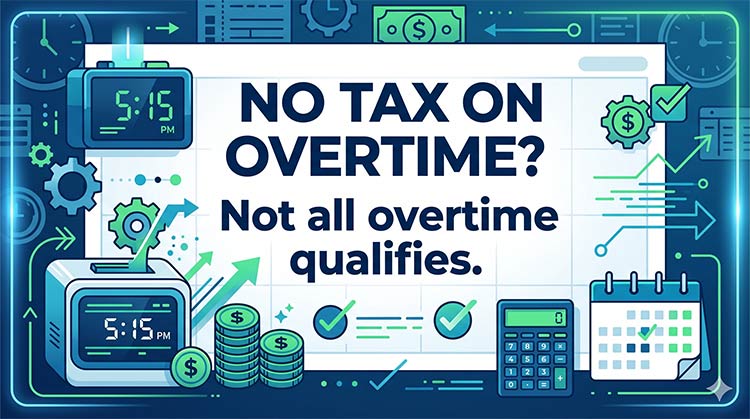
No Tax on Overtime? What the New 2025 Overtime Deduction Really Means

No-Tax-on-Overtime-cover

 No Tax on Overtime

No Tax on Overtime? What the New 2025 Overtime Deduction Really Means

Beginning with the 2025 tax year, a new federal deduction may allow certain workers to reduce their federal taxable income for some overtime pay.

This new rule is commonly being called No Tax on Overtime. That sounds wonderful. It also sounds much simpler than it really is, which is usually where the tax code walks in wearing muddy boots.

The rule does not mean that all overtime wages are tax-free. It does not mean payroll stops withholding taxes on overtime. It does not mean the full time-and-a-half paycheck disappears from taxable income.

What it means: Eligible taxpayers may be able to deduct the qualified overtime premium portion of their overtime pay on their federal income tax return.

For tax years 2025 through 2028, the deduction generally applies to the portion of qualified overtime compensation that exceeds the worker's regular rate of pay, such as the half portion of time-and-a-half compensation required under the Fair Labor Standards Act, commonly called the FLSA.

0
  266 Hits

1099 Reporting Just Changed for 2026

1099s-for-202_20260514-052849_1

1099s for 202 20260514 052849 1

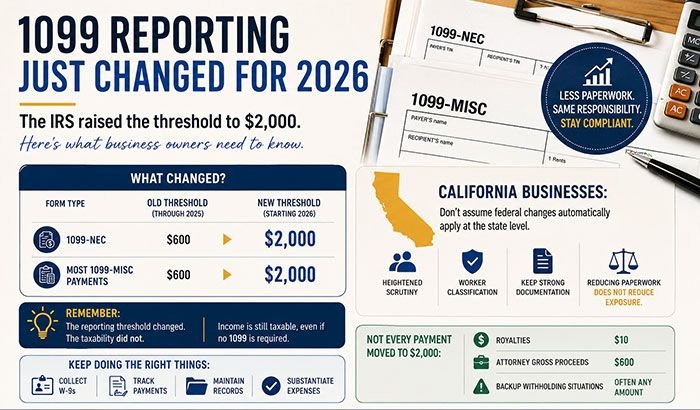
 1099 Reporting Just Changed for 2026

The IRS Raised the Threshold to $2,000. Here’s What Business Owners Need to Know.

For years, business owners have been trained like Pavlov’s accountant:

“Pay someone over $600? Issue a 1099.”

That rule became so embedded into bookkeeping and tax workflows that many businesses treated it like gravity. Not necessarily because they understood it, but because fighting gravity usually ends badly.

Now, beginning with payments made in 2026, the federal reporting threshold for many Forms 1099 increases from $600 to $2,000.

At first glance, this sounds like welcome relief:

  • Fewer forms
  • Less administrative work
  • Lower compliance burden
  • Fewer January panic attacks involving missing W-9s

But as with most tax changes, the surface simplicity hides several traps underneath.

Let’s break down what changed, what did not change, and why businesses should still proceed carefully.

0
  545 Hits